raw, or they prepared meals for their dogs using ingredients from the same sources that they would use for themselves. (Not necessarily the same ingredients, though, as they would use such great
as lungs, stomachs,
udder, and
connective tissue to feed their dogs.) Also, dogs were not routinely spayed or neutered at an early age.
During my first two weeks in the USA, however, I personally met two dogs dying from cancer. I thought it was a coincidence, but I was shocked to find out how many pet owners have
lost dogs to this disease, as well as were battling many
in their dogs, including kidney, liver, and digestive problems, allergies, really poor dental health, etc. All of them fed commercial brands of dog food,
sometimes those recommended by their vet.
Vets go to school to study the internal systems of many different types of animals and birds. They also study different animal diseases and how to treat them. They are doctors, not
necessarily
. Their focus is in helping sick or injured animals, not how to produce healthy, top quality dogs with outstanding coats, joints, bones, skin etc, which can perform at shows and trials, or be used in a breeding
program. It’s typically top breeders and show people that have the benefit of years of experience in raising and researching one
specific breed of dogs.
of the German Shepherd Dog. They usually don’t have breed specific information and may
have limited knowledge of how a German Shepherd puppy develops differently from other breeds of dogs. Most vets, when seeing a German Shepherd puppy in a healthy, fit condition will advise the owner to “put some weight on’em.” Don’t do
it! And also don’t follow suggested feeding amounts on your bag of dog food. Most often you have to cut that amount almost in half for your German Shepherd puppy. German Shepherd puppies need to stay
while growing. They
will
grow large, and strong, and fit. If you like a heavier dog, you will always be able to let him "fill in" later, but please do not destroy his growing joints with excess weight during the early growth period.
So, back to feeding your dog. Of course everyone knows that a
. If you only take a look at a dog’s digestive system, the teeth and skull anatomy, and the
way they
are built, it becomes very clear that these animals have developed to tear their food off, shear it, not chew or crush it as a cow, horse, or a human would. They have sharp pointed teeth, strong jaw musculature, and don’t have any
digestive enzymes in their mouth as humans, for example, do. When they chew things, they only do so to cut their food down into pieces small enough to swallow. Being carnivores, dogs have a very difficult time digesting
.
Animals
that evolved to digest grains and whose primary dietary component is carbohydrates, have intestines two-three times longer than that of a dog, and they often “pre-digest” their food while chewing it. They also have different enzymes and
acidity levels in their stomach. So when pet food companies use
in their products, it increases the amount of protein that they can put on the label, but how much of that plant protein will your dog be able to use?
When you feed your dog raw foods such as meat with bones, fat, and organ parts, your dog digests this raw food completely in about 3-5 hours, producing very small stools. When you
feed your dog grain-loaded kibble, it may sit in the digestive tract for up to 15 hours, all along poisoning your dog’s system, undermining his immune system, thus predisposing him to cancer and allergies, as well as creating the perfect
breeding
grounds for
.
Feeding your dog kibble is no doubt very convenient, just like eating in a fast food restaurant. Sure we all can survive a Big Mac now and then, but imagine eating fast food every
day of your life, all your life. What kind of health would you have? What kind of health can you expect your dog to have when feeding him
There are high quality kinds of kibble available now that don’t use wheat, soy, corn, etc. They are much better than your typical commercial dog food, but they are still
over-processed and "dead." There is nothing that can substitute for a raw meat diet for your dog – you will never get complete amino-acids, enzymes and vitamins that your dog needs for his digestion, immune system and clean teeth from
cooked, ove-processed commercial dog food.
Due to the numerous health problems that arise from feeding commercial dog food, and also due to the recent unfortunate deaths of many dogs because of tainted food, I feel it is
necessary to share how we feed our dogs raw, not only with my puppy owners, but with anyone interested to educate themselves on the subject.

Feeding raw might be a little more time consuming than just filling a bowl with kibble, especially in the beginning, but as you get into a routine of doing it and establish reliable sources
of your raw ingredients, it really becomes just about as easy.
The base of our dogs' diet is
chicken. It is inexpensive, readily available, easy for dogs to digest, and is a great source of bones and fat. Bones, fat, and organs are just as important in your dog’s raw diet as the muscle meat
itself.
Feeding skinless chicken breast is not a complete raw diet! I try to go by the ratio of approximately
25% bone, 20% fat, 15% organs, 35% lean muscle meat, 5% fruits and vegetables for my adult dogs, and a bit more veggies and
variety of
other foods for puppies.
Below is an approximate raw menu that you can use as a
guideline. The great thing about feeding raw is that you don't have to perfectly balance every single meal for your dog. I know some of you have the horrifying picture of
spending hours grinding and mixing endless bloody ingredients, trying to achieve perfect percentages, and worrying that you are out of liver today. Feeding raw is much simpler. Whatever type of raw food you have today, just hand it to
your dog. Over time, say over a week, try to provide variety and balance.
Puppy 8 to 16 weeks - 3 meals a day:
When raising a puppy, I start each morning with a short, 2-5 minutes
training session, and use boiled beef liver as treats (cut into small cubes). I use a lot of treats in the beginning, therefore the following breakfast is light.
When short on time, I simply scatter the treats in the grass to have the puppy search for it. I recently picked this idea up from the 2009 WUSV SchH3 Champion
Sharon Ronen (Israel) at our club's seminar. She never feeds her
working prospect puppy from a bowl!
The amounts of food that I suggest here are for an 8-weeks old puppy. As your puppy grows, start increasing the amounts gradually, so that by the age of 16 weeks he is eating about twice as much. For example, if it sais to give 1 small
chicken back to an 8 weeks old puppy, then the amount to give to a 16-weeks old is 2 small backs, etc. Please don't feed two chicken backs in one feeding to an 8-10 weeks old pup, that's just way too much. Also, constantly monitor your
puppy's condition (the amount of fat on his ribs). If in doubt, it's better to err on the thinner side! If the puppy is a little too chubby, decrease the amount of food he is getting for at least a week.
Breakfast:
1.
Every other morning I give the following mix: 3 tbsp. of
cottage cheese + 3 tbsp. of plain all natural yogurt + 2
tbsp. freshly ground apple (or
carrot,
sweet potato, banana, blueberries, or other fruits and vegetables. Twice a week add 1
raw egg yolk
to this meal.
The
cottage cheese that we use is "Friendship," no salt
added. I'm sure there are other good brands, but make sure that the ingredients are:
milk. That is what cottage cheese is made out of, and there must be nothing else, except maybe for some vitamins. This is important for you too,
go for
pure products for your family as well.
When it comes to yogurt, I actually prefer the type called
"kefir." The best kind of kefir that I have found is "
Helios Organic Plain Kefir". This is the real deal. I actually enjoy a cup now and then
myself - it's just great for you on so many levels. When they are out of "Helios," I use a different brand, "
Lifeway," but it is not quite as great as "Helios." The bottom line is, whether you are using yogurt
or
kefir, make sure that it is (1) plain, (2) with live cultures (probiotics), (3) with milk fat (do not use fat-free kind), (4) has the most minimal amount of ingredients. All there needs to be is milk and cultures, but you will also
probably find that
most of them have fiber added. That's OK.
When grinding
fruits and vegetables, the smaller you grind them, the better. You can use a blender, or do it
manually. When adding ground fruits and vegetables, especially
carrots, it is best to add a teaspoon of butter (melted), or
some sort of fat. This helps absorption of vitamin "A" a great deal. I favor carrots because it is believed by many that adding carrots to your dog's diet regularly will
intensify the red in his coat. I don't know this for a fact,
but
it doesn't hurt, right? Also,
blueberries, although expensive, are one of those "super-foods," packed with vitamin "C". Add them to your puppy's diet whenever you can, even if just a teaspoon. A cheaper alternative is sweet
potatoes.
2.
Other mornings, I feed
The Honest Kitchen
products, according to the directions on the package. My favorite kinds for puppies are "Keen" and "Verve." They do contain some grain such as oats or rye, but I find that for puppies, they are most palatable and produce the best stool.
Lunch:
One very small (or 1/2 large) raw
chicken back.
An average
chicken back weighs about 250 g or 1/2 lbs.
Make sure to leave all the
skin and fat on it. Dogs don't have cholesterol problems, and your dog really needs the fat, as it is an excellent
source of energy for carnivores. (By the way, if your puppy or dog is too thin,
the healthiest and easiest
way to have him gain weight is to increase the amounts of fat in his diet).
Now, of course we have to talk about
safe handling of raw chicken, or any other type of raw meat. If you buy
in bulk
(and you should buy at least a few days worth), freeze everything except for the amount that you will use within the next two days. What will be used within the next two days should be stored in the refrigerator, under a plastic film or
in a sealed plastic bag. Use
one special cutting board for meat only, which should never be used for fruits and vegetables. Wash you hands with soap after handling of raw meat.
All these precautions are so that YOU don't get sick. "But what about the puppy? Can't they get sick from eating raw meat? Isn't
Salmonella deadly?" Dogs have iron stomachs when it comes to things like that. They have a very high
acidity
content (4-5 times higher than humans!), which enables them to digest bones and to kill bacteria. Numerous times I’ve given my dogs meat that was “slightly off,” they loved it and were totally fine. Think about them burying their prey in
the wild for a few days to finish it off later - there is a very small (and I mean tiny) chance for your dog to become sick from consuming raw meat. It's much less common or dangerous than all
the deadly things dogs get from eating kibble. One thing for sure - never boil or heaven forbid microwave the chicken for your dog.
Boiling kills the whole concept of feeding raw, plus, if it contains bones, they can become
brittle and very dangerous for your dog.
Where do we get our chicken backs? We buy "
Bell & Evans"
chicken backs by the case at
Dekalb Farmers Market in Decatur, GA and, Whole Foods Market also carries chicken
backs sometimes.
Dinner:
For the last feeding, choose one of the following meals:
1.
Raw beef (1/3 lbs per feeding, up to 1 lb for a 16-month-old). Do not use ground beef. Instead, cut it into small pieces, or you can give one large piece to your puppy to chew on. No need to go for filet minion - any discounted piece of
beef at your butcher
will be great. Please do not buy those prepackaged meats, they are often full of "extenders," sodium, and who knows what else. Try to find a real butcher or a farmers market in your area, great for both your dog and your family.
2.
Raw turkey (1/3 lbs per feeding, up to 1 lb for a 16-month-old). What I usually do is buy turkey
drumsticks or thighs (great value), cut the meat off the bone in large chunks, and give about 1/3 lb piece per feeding. All skin and
connective tissue included.
Actually, I might still give it
"bone in" to young puppies, but I watch them closely with it, and as soon as I see that their teeth become strong enough to chew through the bone, I stop giving them these bones. I know, raw feeding
purists will say that they give thigh and drumsticks with the bone to their dogs all the time without any ill effect. But I can't help but worry about the sharp pieces that these bone can produce. I will still give raw chicken leg bones
to my dogs, but not from larger birds/animals.
3.
1/2
raw frozen sardine, as is, with all bones, head, scales,
etc. Do not thaw. It might take a little while for your puppy to start accepting sardines as food - keep offering it, skip a meal or two if you have to - the benefits of feeding raw sardines are just too great. Being a fatty salt water
fish, it is an unsurpassed source of
Omega-3 and
Omega-6 fatty acids. (By the way, I read somewhere that dogs don't absorb these essential fatty acids from flax seed or other vegetarian sources). These will do wonders for
your puppy's
coat and skin, brain tissue development, AND, while eating the whole fish, your puppy will also eat the plankton, seaweed, and other wonderful stuff that the fish was eating in the ocean - what a perfect way to add
minerals and
vitamins to his diet! Give this 2 times a week, and a 16-weeks old puppy can even get 2 sardines in one feeding.
4.
1/3 lbs (up to 1 lb for a 16-month-old)
raw green tripe (stomach
from cow, sheep, deer, etc). I
use "Blue Ridge Beef" prepackaged and frozen green tripe. It's just so much more convenient than struggling to cut a whole 50 lbs cow stomach into pieces! If you can't find "Blue Ridge Beef" products in your area (they have a store
locator on their website), find
green tripe in a can at your local private pet store, brands such as BG (Before Grain), Solid Gold, and my favorite, Tripett "Green Venison", make canned green tripe. Green tripe is an excellent
source of digestive
enzymes, and also half-digested particles of grass that the cow or deer was enjoying. Give this 2 times a week. Don't bother buying
white bleached tripe sometimes found in grocery stores. It is stripped of all it's useful goodness
and
adds no value to your dog's diet.
5.
1/3 lbs (up to 1 lb for a 16-weeks old) raw organs. You can give your puppy beef or chicken liver, heart, kidneys, or a mix of these. I use "Blue Ridge Beef" prepackaged and frozen "
Natural Mix" which is a mix of various beef organs, already cut up into pieces. Very convenient
compared to cutting and mixing these myself. Give this 1-2 times a week.
6.
1/2 lbs raw beef/lamb/
goat
neck or ribs with meat on, or other meaty bones. Give this once a week, or more often instead of chicken backs.
So to sum it up and give you an example of how to make your puppy's diet
balanced, here is an approximate weekly schedule:
Mon: cottage cheese mix + egg yolk, chicken back, beef;
Tue: The Hones Kitchen, chicken back, sardine;
Wed: cottage cheese mix, chicken back, tripe;
Thu: The Hones Kitchen, chicken back, organs;
Fri: cottage cheese mix + egg yolk, chicken back, sardine;
Sat: The Hones Kitchen, chicken back, tripe;
Sun: cottage cheese mix, chicken back, beef neck;
Mon: The Hones Kitchen, chicken back, sardine;
Tue: cottage cheese mix + egg yolk, chicken back, tripe;
Wed: The Hones Kitchen, chicken back, turkey;
Thu: cottage cheese mix, chicken back, sardine;
Fri: The Hones Kitchen, chicken back, tripe;
Sat: cottage cheese mix + egg yolk, chicken back, organs;
Sun: The Hones Kitchen, chicken back, sardine;
The diet description for this age group would not be
complete without me mentioning
marrow bones. These make the perfect "chew" for your puppy.
These will give any commercial "bacon-flavored," "dental," "smoked all natural," "disinfected and re-stuffed" bone that you find in a pet store a run for it's money. These raw marrow bones provide hours of entertainment, teeth-cleaning,
help with teething, exercise (not just for jaws, for the entire body - just watch your puppy working on it), and help your German Shepherd puppy's ears stand strong. Stock up on these and give them to your puppy
every other day if
you like. Remove and throw away the next day, even if unfinished. After 7 months of age I only give these occasionally, and only under supervision as hard bones like these can wear out their teeth. Especially this is true for aggressive
chewers.
Cooking vegetable stew for your puppy:
I used to cook a great deal for my dogs, but after doing a lot of research, decided to switch them to a mostly
grain-free diet. I made this switch about 3 years ago, and love the results. The dogs look fantastic, with healthy
shiny coats, bright eyes, and they are full of energy. Plus, it makes my life much easier too: no need to cook a huge pot of food every day, no need to wash dishes, and much less clean up in the yard. However, I will still cook a pot of
stew for them a couple of times a month. This gives me an opportunity to add all kinds of
vegetables to their diet. Here is how I cook it:
I usually use broth left from boiling liver for their treats, but you can use any type of home-made broth. Just boil some chicken, beef, or even use canned salmon to prepare it. If using raw meat, boil it for 30 minutes before starting
to add veggies. Remove all bones when it's done, no cooked bones! When using canned fish, start adding veggies as soon as it boils. Canned fish bones are safe.
30 minutes before the end of cooking time, I add barley (if using), potatoes, beats
20 minutes before the end of cooking time, I add sweet potatoes, carrots, green peas, green beans, broccoli, kale, oats (if using)
10 minutes before the end of cooking time, I add tomatoes (will often use canned), spinach, apples/pears, lots of parsley (vit B source)
Also, I add 1 tsp (for a large 8 quart pot) of salt.
No one really knows how much vegetables to give to a dog. Some people give none, and some give a mix of all of the above (blended) every single day. Like I said, I personally feed vegetable stew to my dogs about twice a month. Sometimes
more often. I don't necessarily use ALL of the above ingredients every time, but try to add the majority of them.
You can store this stew in refrigerator for up to 3-4 days, and feed every day to your puppy while you have it. No harm can be dome with this. The amount to feed is about 1 soup ladle full at 8 weeks, 2 at 10 weeks, 3 at 12 weeks, 4 at 6
months to adult.
Puppy 4 to 8 months – 2 meals a day:
I use all the same types of food as for the younger puppy, except that I substitute some of the breakfasts for meaty options. By 8 months of age, the puppy gets cottage cheese mix about once a week, and the same is true for "The Honest
Kitchen" food.
Keep increasing the amount of food gradually, and keep watching your
puppy's weight. You should be able to feel his ribs very easily, and see the two - three last ribs simply by looking at your puppy. If you don't see them, or if you feel a layer of fat as you run your fingers over his ribs,
decrease the
amount of food per feeding. It will take about
a week before you can see the results. If there is no change after a week, decrease the amount some more. The same way, if you start seeing all the ribs when looking at your puppy,
increase the
amount of food per feeding and see if there is a change in about a week.
It's impossible to give exact feeding amounts for each age - you will always have to "tweak" them, all along watching your dog's condition closely. Same with the
ideal weight for a puppy of a certain age. There is no such thing. Some puppies have stronger bone and are heavier, some puppies are taller, etc. We never go by a specific weight for a puppy - we only watch his physical condition
and
adjust the amounts of food accordingly. Here is an approximate
balanced feeding schedule:
Mon: cottage cheese mix + 2 egg yolks, 2-3 chicken backs;
Tue: 2-3 sardines, 2 chicken backs;
Wed: 1 lb. organ mix, 2 lbs. goat ribs;
Thu: 1 lb. turkey, 2-3 sardines;
Fri: 1 lb. beef, 2-3 chicken backs;
Sat: "The Honest Kitchen", 1 lb. tripe;
Sun: 2-3 sardines, 2-3 chicken backs;
After 8 months of age:
At about 8 months we start feeding our puppies once a day, just like we feed our
adult dogs. An adult GSD eats 1.5 - 2.5 lbs of raw food per day (per feeding). Below is an example of one month worth of feedings:
day 1 - raw chicken backs
day 2 - raw chicken backs
day 3 - raw
salmon heads*
day 4 - raw chicken backs
day 5 - raw beaver meat
day 6 - raw organ mix (beef) + 1 carrot + 4 tbsp. canned pumpkin + 1 raw egg yolk
day 7 - raw chicken backs
day 8 - raw green tripe
day 9 - raw deer ribs and trimmings
day 10 - raw deer meat
day 11 - raw deer meat
day 12 - raw sardines
day 13 - raw chicken backs
day 14 - raw organ mix (chicken)
day 15 - vegetable stew + 4 tbsp. canned pumpkin + 2 tbsp blueberries + 1 raw egg yolk
day 16 - raw chicken thighs
day 17 - raw chicken backs
day 18 - raw green tripe
day 19 - raw sardines
day 20 - raw chicken backs
day 21 - raw turkey
day 22 - raw goat neck/rib bones with meat
day 23 - raw chicken backs
day 24 - raw organ mix (beef)
day 25 - raw chicken backs
day 26 - lean beef
day 27 - raw chicken backs
day 28 - raw sardines
day 29 - raw chicken backs
day 30 - vegetable stew + 4 tbsp. canned pumpkin + 2 tbsp blueberries + 1 raw egg yolk
* If feeding raw
salmon heads, you must be aware of the
Salmon Poisoning Disease.
The amount of food per feeding can differ quite a lot from dog to dog. For example, when it comes to chicken backs, some of our dogs need 3 per day (1.5 lbs), and some - 4-5 (2-2.5 lbs). Keep in mind that chicken backs are quite fatty.
Sardines - we feed 3-6 sardines to each dog per feeding. Organ mix, tripe, and lean beef - 2 lbs per dog per feeding. Again, these are the amounts that work for our dogs. What you need to do is to watch your own dog's
physical
condition
and adjust the amounts accordingly (did I say this enough times already? I know, but it's just very important).
This list of foods is not
set in stone - provide variety whenever you can, and use what you have available in your area. For example, during the deer hunting season we use deer ribs, necks, shoulder-blades, meat and trimmings a
lot.
Also, if you find a real butcher in your area, ask for tracheas and lungs. These are a great addition to your dog's diet as well. If you live near an ostrich or kangaroo farm - sure, go ahead and use this opportunity as well!
Note: please do not feed
treats to your dog throughout the day. You will most likely create bad habits and unbalanced nutrition. You dog doesn't need them, and "What a good boy!" and some play are wonderful rewards all by
themselves. Reserve the treats for the training sessions.
WARNING: Never feed your dog
cooked bones of
any kind. They are brittle and can damage your dog's digestive tract.
|
|
If you've found this article helpful, please donate to show your support. |
Copyright 2010-2013. For information on making use of this article see


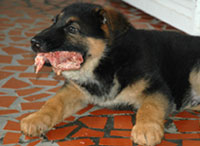 So, back to feeding your dog. Of course everyone knows that a dog is a carnivore. If you only take a look at a dog’s digestive system, the teeth and skull anatomy, and the
way they
are built, it becomes very clear that these animals have developed to tear their food off, shear it, not chew or crush it as a cow, horse, or a human would. They have sharp pointed teeth, strong jaw musculature, and don’t have any
digestive enzymes in their mouth as humans, for example, do. When they chew things, they only do so to cut their food down into pieces small enough to swallow. Being carnivores, dogs have a very difficult time digesting grains.
Animals
that evolved to digest grains and whose primary dietary component is carbohydrates, have intestines two-three times longer than that of a dog, and they often “pre-digest” their food while chewing it. They also have different enzymes and
acidity levels in their stomach. So when pet food companies use soy in their products, it increases the amount of protein that they can put on the label, but how much of that plant protein will your dog be able to use?
So, back to feeding your dog. Of course everyone knows that a dog is a carnivore. If you only take a look at a dog’s digestive system, the teeth and skull anatomy, and the
way they
are built, it becomes very clear that these animals have developed to tear their food off, shear it, not chew or crush it as a cow, horse, or a human would. They have sharp pointed teeth, strong jaw musculature, and don’t have any
digestive enzymes in their mouth as humans, for example, do. When they chew things, they only do so to cut their food down into pieces small enough to swallow. Being carnivores, dogs have a very difficult time digesting grains.
Animals
that evolved to digest grains and whose primary dietary component is carbohydrates, have intestines two-three times longer than that of a dog, and they often “pre-digest” their food while chewing it. They also have different enzymes and
acidity levels in their stomach. So when pet food companies use soy in their products, it increases the amount of protein that they can put on the label, but how much of that plant protein will your dog be able to use?